How a Large Language Model works
A deep dive into the real mechanics — and how this project simulates them.
🧠 1. What is a Large Language Model?
A Large Language Model (LLM) is a neural network trained to predict the most likely next word (or token) given everything that came before it. That's it. The surprising thing is that a single objective — predict the next token — turns out to be enough to learn grammar, facts, reasoning patterns, and even code, if you train on enough text.
Modern LLMs are built on the Transformer architecture (introduced by Google in 2017). A Transformer stacks many identical layers, each of which applies a mechanism called self-attention to find relationships between all tokens in the current context simultaneously.
The pipeline from text to answer involves four conceptually distinct stages: tokenize → embed → process → generate. The rest of this page explains each one.
✂️ 2. Tokenization — text becomes numbers
Neural networks can only process numbers, so the first step is converting text into a sequence of integers called token IDs. A tokenizer splits the input string into tokens — units that may be whole words, sub-words, or single characters — and maps each to an integer from a fixed vocabulary.
Real LLMs: Byte-Pair Encoding (BPE)
Most modern LLMs use BPE or a variant (SentencePiece, WordPiece). BPE starts with a vocabulary of individual bytes and repeatedly merges the most frequent adjacent pair. This lets the tokenizer handle any input (it can always fall back to byte-level) while keeping common words as single tokens.
Why sub-word tokenization?
Pure word-based tokenizers fail on rare words and typos. Character-based tokenizers produce very long sequences and slow down training. Sub-word tokenization is the sweet spot: common words are one token, rare words are split into familiar sub-parts.
SimpleTokenizer uses a regex to split on whitespace and punctuation
(\w+|[^\w\s]) and assigns a fresh integer ID to every new surface form
it encounters. The vocabulary grows dynamically at runtime. This makes the
encode/decode pipeline fully transparent and easy to inspect in the trace —
but it is not how real tokenizers work.
🔢 3. Embeddings — numbers become vectors
A token ID like 2963 is just an index. Before the Transformer can
work with it, each ID is converted into a dense vector (a list of
floating-point numbers, typically 768–8192 dimensions) called an
embedding.
Think of an embedding as a point in a very high-dimensional space. The training process arranges these points so that semantically similar tokens end up nearby: "king" and "queen" are close; "banana" and "circuit" are far apart.
👁️ 4. Attention — context shapes meaning
The core innovation of the Transformer is self-attention. At each layer, every token looks at every other token and decides how much it should "attend to" them when building its own representation.
Concretely: for each token, three vectors are computed — Query (Q), Key (K), and Value (V). Attention scores are the dot product of Q with all K vectors, normalised by softmax. The output is a weighted sum of V vectors.
In plain English: "The word 'it' in 'The animal was tired because it…' attends strongly to 'animal', so the model represents 'it' as meaning 'the animal'." Attention allows the model to resolve such references regardless of how far apart the tokens are.
Multi-head attention
In practice, attention is computed h times in parallel with different learned projections (the "heads"). Each head can specialise in a different type of relationship: one might track syntax, another coreference, another semantic similarity. The outputs of all heads are concatenated and projected back to the model dimension.
⚡ 5. The generation loop — one token at a time
LLMs generate text autoregressively: one token at a time, each new token conditioned on everything generated so far.
LLMCore.generate() does iterate token-by-token.
For each step it:
- Draws
top_kcandidate tokens (the correct one + random distractors from the vocabulary). - Assigns a pseudo-random base score to each candidate.
- Applies a repetition penalty to tokens seen in the last 10 context tokens.
- Boosts the target token so the demo output remains coherent.
- Applies temperature-scaled softmax.
- Logs the full probability table to the trace.
🌡️ 6. Softmax & temperature — shaping the distribution
After the forward pass, the model has a raw score (logit) for every token in the vocabulary. Softmax converts those scores into a proper probability distribution: all values become positive and sum to exactly 1.
What does temperature do?
Temperature T is applied as a divisor before the exponential:
- T = 1.0 — the model's learned distribution, unchanged.
- T < 1 — sharpens the distribution; the top token becomes even more dominant. More deterministic, less creative.
- T > 1 — flattens the distribution; gives more probability mass to unlikely tokens. More diverse, more "creative" (and more likely to be wrong).
- T → 0 — greedy decoding: always picks the single most probable token.
Here's an example showing how temperature changes a concrete distribution:
Other sampling strategies
Temperature is often combined with:
- Top-k sampling — only sample from the k most probable tokens (discard everything else).
- Top-p (nucleus) sampling — only sample from the smallest set of tokens whose cumulative probability exceeds p (e.g. 0.9).
- Repetition penalty — reduce the score of tokens that already appeared in the context, to discourage repetitive output.
🤖 7. Agents & tool use
A bare LLM is a text-in / text-out function. It cannot browse the web, run code, or call an API. Agents extend LLMs with the ability to use tools and take multi-step actions.
How tool use works in real systems
Modern frameworks (OpenAI function calling, Anthropic tool use) work roughly like this:
- A list of available tools (name, description, JSON schema of parameters) is prepended to the system prompt.
- The LLM is fine-tuned to output a structured JSON block when it decides a tool is needed (instead of plain text).
- The host application parses that JSON, calls the real tool, and inserts the result back into the conversation as a new message.
- The LLM continues generating from there, now with the tool result in its context.
Chain-of-thought reasoning
Before deciding which tool to call (or whether to call one at all), frontier models often produce a reasoning trace — a scratchpad of intermediate thoughts. In the OpenAI "o" series and DeepSeek-R1, this trace is explicit and inspectable. In older models it was hidden or only possible via prompting ("Let's think step by step").
ReasoningAgent uses simple rule-based heuristics instead of an LLM:
- If the query contains an arithmetic expression + a trigger word ("calculate", "what is", …) → call the Calculator tool.
- If it starts with a factual question word ("what is", "explain", …) → call the FakeSearch tool (in-memory knowledge base).
- Otherwise → skip tools and go straight to the LLM core.
CalculatorTool uses Python's eval(), but only after
validating the expression against a strict regex whitelist
(^[\d\s\+\-\*\/\(\)\.]+$) and executing with
__builtins__={} — so there is no access to any Python built-in
or variable. Even so, eval() should never be used on untrusted
input in a real production system.
🔬 8. What this simulation actually does
The full pipeline, from the moment you hit Ask → to the moment the trace is ready:
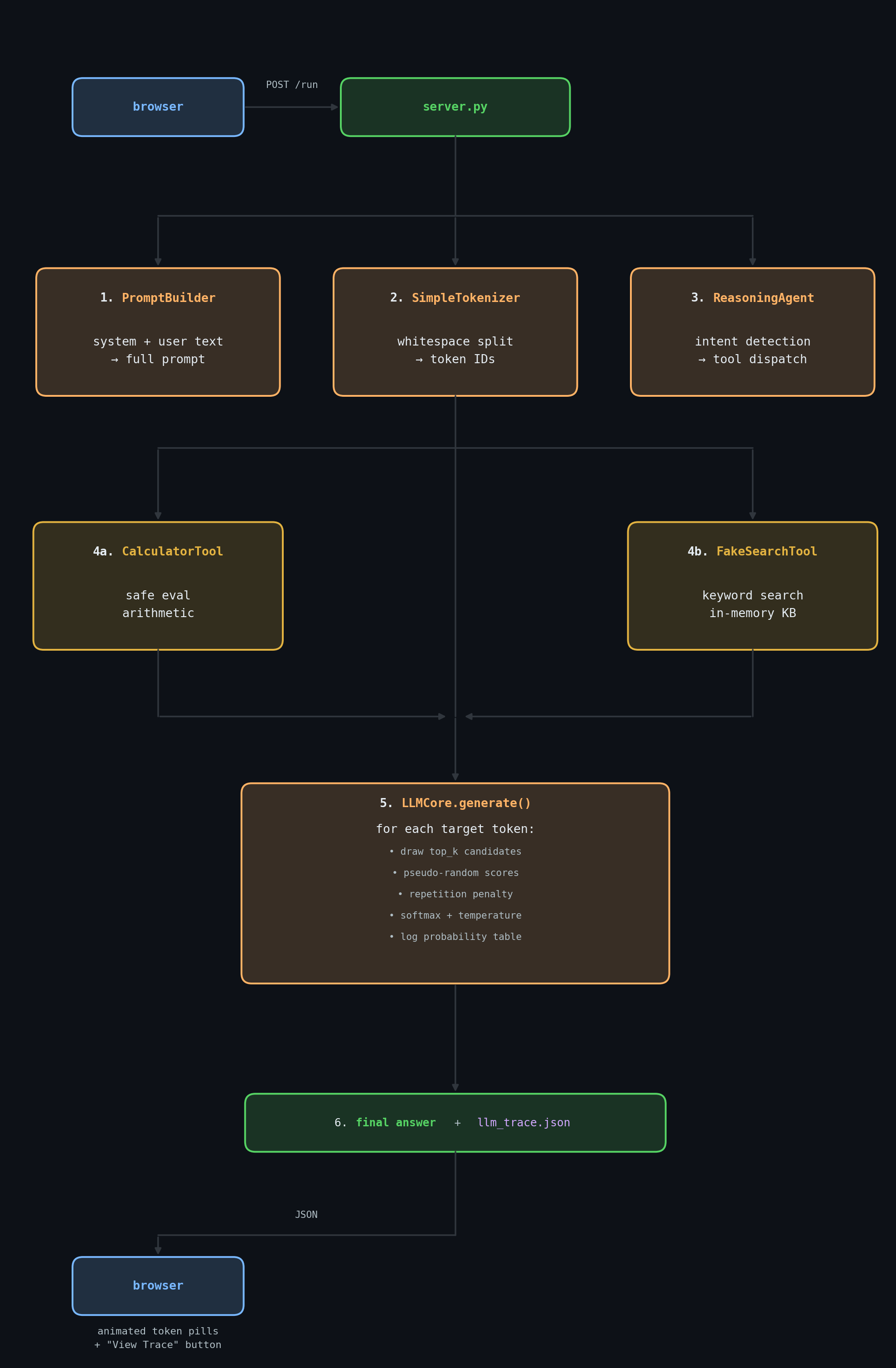
Every one of these steps writes a TraceStep into the append-only
Trace object. At the end the trace is serialised to
llm_trace.json and served at GET /llm_trace.json.
The Trace Viewer fetches it and renders every step as an expandable card.
Real vs. simulated — side by side
| Aspect | Real LLM | This simulation |
|---|---|---|
| Tokenizer | BPE / WordPiece, fixed vocabulary of 32k–200k tokens | Whitespace + punctuation regex, dynamic vocabulary |
| Embeddings | Learned dense vectors (768–8192 dims) | Not implemented — skipped |
| Attention | Multi-head self-attention across full context | Not implemented — context is just a list of IDs |
| Token scores | Output of the final linear layer (learned logits) | Pseudo-random scores + repetition penalty heuristic |
| Softmax | Applied to all ~100k logits | Applied to top_k=6 candidates — same math, smaller scale |
| Temperature | Scales logits before softmax | Same formula, same effect — fully functional |
| Sampling | Draw from distribution (top-p / top-k) | Target token is forced (but probability table is real) |
| Tool use | LLM outputs structured JSON; framework parses it | Rule-based intent detection; same logical structure |
| Reasoning trace | Hidden (or via CoT prompting / o-series) | Explicit, logged to trace at every step |
| Observability | Black box (unless you add logging) | Every decision visible in the Trace Viewer |
⚠️ 9. What this simulation cannot show
This project is deliberately simplified for educational purposes. Here are the most important things that are not represented:
- Emergent capabilities — the ability to translate, reason about logic, write code, etc. comes from training on enormous datasets with billions of parameters, not from the architecture alone.
- RLHF / RLAIF — modern assistants (ChatGPT, Claude) are fine-tuned with reinforcement learning from human (or AI) feedback, which fundamentally shapes tone, safety, and instruction-following.
- True semantic understanding — the simulation's token scores are random; a real model's scores encode the statistical regularities of human language.
- KV-cache — real inference reuses the key/value tensors from previous tokens to avoid re-computing the full forward pass at every step (huge performance win). Not relevant here since there is no forward pass.
- Quantization & hardware — running a 70B model requires tens of GB of VRAM. Techniques like 4-bit quantization (GGUF) and speculative decoding are critical in practice.
- Attention Is All You Need — Vaswani et al. (2017), the original Transformer paper
- The Illustrated GPT-2 by Jay Alammar — incredibly clear visual walkthrough
- nanoGPT by Andrej Karpathy — a minimal, readable GPT implementation in ~300 lines of Python
- Let's build GPT — Karpathy's 3-hour video building a GPT from scratch
Ready to see the pipeline in action?
Ask a question →